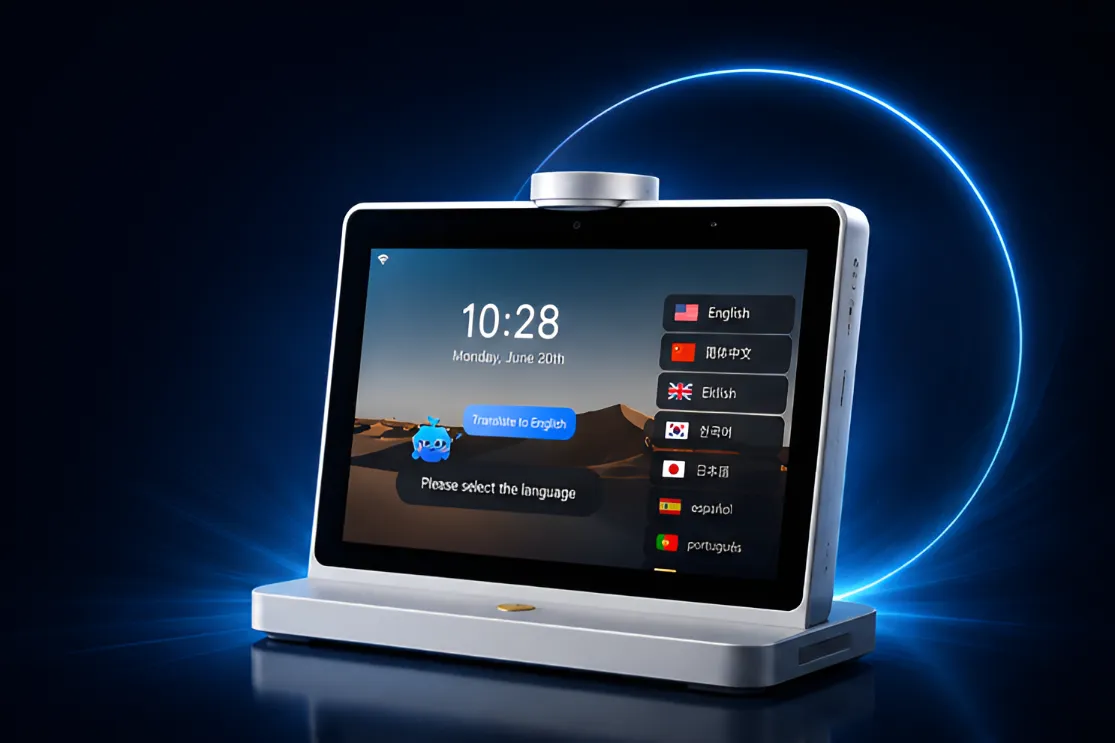
Phone translation apps work fine for a menu and badly at a reception desk. What changes with a dedicated station, three situations where it earns its cost, and what to check before buying one.
The cost of a missed sentence
In a hotel, a misunderstood request becomes a complaint. In a clinic, it becomes a medical risk. In an office, it becomes a contract clause nobody agreed to. The cost of a language gap is rarely the awkward moment itself — it is what happens afterwards.
Most businesses serving international visitors have quietly absorbed this cost. Staff improvise with phone apps, gestures and a colleague who speaks some English, and everyone treats the friction as normal. It is worth pricing that friction honestly before deciding it is acceptable.
Why phone apps break down at the counter
They are excellent tools used in the wrong place. At a reception desk the problems are practical rather than linguistic.
The phone belongs to a member of staff, so it leaves when they do, taking the conversation with it. Only one person can see the screen, so the guest cannot tell whether they were understood. Someone has to unlock, open, choose a language and hold the device at an angle that works for two people — every single time. And in a noisy lobby, a phone microphone picks up the lobby.
None of this is a flaw in the software. It is a flaw in asking a personal device to do a counter's job.
What a dedicated station changes
A fixed device at the point of contact removes the friction rather than translating faster.
- It is always there and always on. No unlocking, no app, no handover when a shift changes. The guest sees a device whose purpose is obvious and uses it without being invited.
- Both people can see the text. Being able to read what was understood is what turns a translation into a confirmation — and that is what prevents the complaint later.
- It is built for all-day use. Mains power and a microphone meant for a room, not a pocket, which is the difference that actually shows up in a noisy space.
- It covers the languages you did not plan for. Over a hundred of them, which matters on the day someone arrives speaking the one language nobody on your team expected.
Three places it earns its cost
Hotel reception. Check-in, requests, and the explanation of something unexpected — a change of room, a problem with a booking, a local rule that needs to be understood rather than nodded at.
Clinic front desk. Symptoms, consent, instructions, follow-up times. Here the printed text is not a convenience; it is a record that the patient saw what was meant.
Offices and airports. Documents, directions, and the kind of exchange where a confident guess is more dangerous than an admission of uncertainty.
What to check before buying
Ask where it will physically sit, and whether power reaches that spot. Ask who will show new staff how it works — a device nobody introduces gets ignored. Ask which languages your actual visitors speak, not which languages the spec sheet advertises.
And test it in the real room before committing. A lobby at 2pm sounds nothing like a showroom, and that is the only acoustic environment whose performance matters.